
Hire Certified Salesforce Developers in the USA

Business growth often leads to Salesforce implementations requiring settings that aren't enough.
Your sales team wants automation for follow-up and repetitive tasks. Customer support requires a more efficient way to manage issues. Finance departments want seamless billing integration. Meanwhile, leadership is asking for real-time dashboards that provide accurate insights. Before you know it, your Salesforce platform evolves into a central operational hub for your business. To meet business requirements, consider hiring a Salesforce developer who can provide tailored Salesforce development services.
"Should we hire a Salesforce developer, and how do we know we're hiring the right one?"
It's one of the most important decisions you'll make during your Salesforce journey. The right developer doesn't just write code—they understand business processes, recommend scalable solutions, and build Salesforce in a way that supports your long-term growth. The wrong hire, however, can lead to poor architecture, unnecessary customization, missed deadlines, and expensive rework.
If you're looking to hire certified Salesforce developers, this guide will help you understand what to look for, when to hire, which certifications matter, how much it costs, and how to choose between freelancers, agencies, and dedicated developers. Whether you're planning your first Salesforce implementation or expanding an existing CRM, this guide will help you make an informed hiring decision.
Why Hiring the Right Salesforce Developer Matters
Many companies assume Salesforce development is simply writing Apex code. In reality, a Salesforce developer influences how your business operates every day.
A skilled developer helps you:
Automate repetitive work
Reduce manual errors
Improve user adoption
Integrate third-party systems
Secure customer data
Build scalable applications
Increase employee productivity
Improve reporting accuracy
Poor development decisions can result in:
Slow Salesforce performance
Duplicate data
Security vulnerabilities
Technical debt
Low user adoption
Expensive future redevelopment
What Does a Salesforce Developer Actually Do?
Many business owners expect Salesforce developers to "build whatever we ask." In reality, experienced developers spend just as much time solving business problems as they do writing code.
Their responsibilities often include:
1. Salesforce Customization
Salesforce customization is about building features that are not available out of the box in Salesforce.
Apex programming: Apex is Salesforce's programming language. Developers use it to create custom business logic when standard automation isn't enough.
Lightning Web Components (LWC): LWC is the modern framework used to create fast, interactive, and user-friendly pages inside Salesforce.
Visualforce (legacy projects): Visualforce is an older technology used to build custom pages in Salesforce. While many businesses now use LWC, developers still maintain Visualforce pages in older Salesforce implementations.
2. Automation
Automation reduces manual work by allowing Salesforce to perform repetitive tasks automatically.
Salesforce Flows: Salesforce Flows automate business processes without requiring extensive coding.
Approval Processes: Approval Processes send records to the appropriate person for review before an action is completed.
Scheduled automation: Scheduled automation runs tasks at a specific date and time.
Trigger optimization: Triggers are Apex code that run automatically on record changes. Developers optimize them for Salesforce efficiency.
3. Third-Party Integrations
Most businesses use multiple software applications. Salesforce developers connect these systems so they can share information automatically.
ERP systems: Connect Enterprise Resource Planning (ERP) software with Salesforce for managing finance, inventory, purchasing, and operations.
Accounting software: Integrating accounting software eliminates duplicate data entry.
Marketing platforms: Developers connect Salesforce with marketing tools to keep customer data synchronized.
Payment gateways: Payment gateway integrations allow businesses to process online payments directly from Salesforce.
REST & SOAP APIs: APIs allow Salesforce to exchange information with other applications securely.
4. Data Management
Good data quality is essential for accurate reporting and better customer relationships.
Data migration: Moving data from an old CRM or spreadsheet into Salesforce.
Data cleansing: Removing incorrect, outdated, or incomplete information from Salesforce.
Duplicate prevention: Developers create rules that prevent duplicate customer records.
Data security: Protecting sensitive business information by controlling who can access specific data.
5. Performance Optimization
As Salesforce grows, developers ensure it remains fast, reliable, and scalable.
Governor limit optimization: Salesforce sets usage limits to keep the platform stable. Developers write efficient code that stays within these limits.
Query optimization: Improving how Salesforce retrieves information from the database.
Code reviews: Developers review each other's code to improve quality, security, and maintainability.
Debugging: Finding and fixing errors when something doesn't work as expected.
6. Deployment
Deployment is the process of moving new features safely from a testing environment into your live Salesforce organization.
Sandboxes: Sandboxes are copies of your Salesforce environment used for development and testing without affecting real business data.
Git: Git is a version control system that tracks code changes and allows developers to collaborate safely.
CI/CD: CI/CD automates testing and deployment, making software releases faster and more reliable.
Change Sets: Change Sets are Salesforce's built-in tool for moving customizations between Salesforce environments.
DevOps Center: Salesforce DevOps Center helps teams manage development, testing, collaboration, and deployments using modern DevOps practices.
Why Businesses Hire Salesforce Developers
Almost every business that adopts Salesforce eventually needs someone to make it fit their actual processes. Here's what typically drives that need:
Salesforce Customization: Standard fields and page layouts rarely match specific sales or service team processes. Developers build custom objects, layouts, and logic that mirror real business processes instead of forcing teams to adapt to Salesforce's defaults.
Process automation: Manually updating records, sending follow-up emails, or routing leads wastes hours every week. Developers build Flows and Apex automation that handle this in the background.
Third-party integrations: Most businesses run Salesforce alongside NetSuite, QuickBooks, HubSpot, Slack, DocuSign, or industry-specific tools. Someone has to build and maintain the connections between them.
AppExchange app customization: Pre-built apps from the AppExchange often need configuration or custom code to fit a specific workflow rather than working perfectly out of the box.
Agentforce (AI features): Einstein and Agentforce capabilities need setup, prompt configuration, and often custom logic to connect predictions or generated actions to real business processes.
Lightning Experience builds: Migrating from Salesforce Classic or building new Lightning app pages and components requires developer involvement for anything beyond basic drag-and-drop.
Apex-based business logic: Complex approval chains, calculations, or multi-object logic that declarative (no-code) tools can't handle cleanly.
Data migration: Moving from a legacy CRM or spreadsheet-based system into Salesforce without losing data integrity is a specialized skill, not a weekend project.
Ongoing support: Salesforce releases three major updates a year. Someone needs to test those releases against your customizations and keep things running smoothly.
When Should You Hire a Salesforce Developer?
You're Implementing Salesforce for the First Time
A certified Salesforce developer ensures your CRM is designed correctly from day one, avoiding costly structural mistakes that are difficult to correct later.
Your Business Processes are becoming complex.
Simple "point-and-click" configurations eventually reach their limits. When workflows begin involving multiple departments, deep logical conditions, or heavily custom layouts, writing code becomes necessary.
You Need Third-Party Integrations
Your systems shouldn't operate in silos. A developer is required to securely connect Salesforce with external platforms such as:
ERP systems: SAP, NetSuite
Financial software: QuickBooks, Stripe
Sales & Collaboration: HubSpot, Slack, DocuSign
You Want to Automate Manual Processes
Eliminate human error and bottlenecks by introducing sophisticated code-driven automation for complex tasks:
Automatic document and contract generation
Dynamic lead routing based on territories or performance metrics
Automated customer support case assignments
Multi-level approval chains for sales opportunities
Complex quote and invoice generation
Your Current Salesforce Is Slow
System lags, slow loading pages, and errors during saves often point to inefficient database queries, bloated code, or poor system architecture. A developer can audit and optimize the performance.
You're Scaling Rapidly
Rapid organizational growth requires a scalable technical architecture that can handle larger volumes of data, users, and API calls without crashing.
Salesforce Admin vs. Salesforce Developer
It's common to confuse these two essential roles. While they work in the same system, they use completely different tools to solve business challenges:
| Salesforce Admin | Salesforce Developer |
|---|---|
| Configuration | Custom Development |
| Reports | Apex |
| Dashboards | LWC |
| User Management | APIs |
| Flows | Complex Automation |
| Security | Integrations |
Types of Salesforce Developers
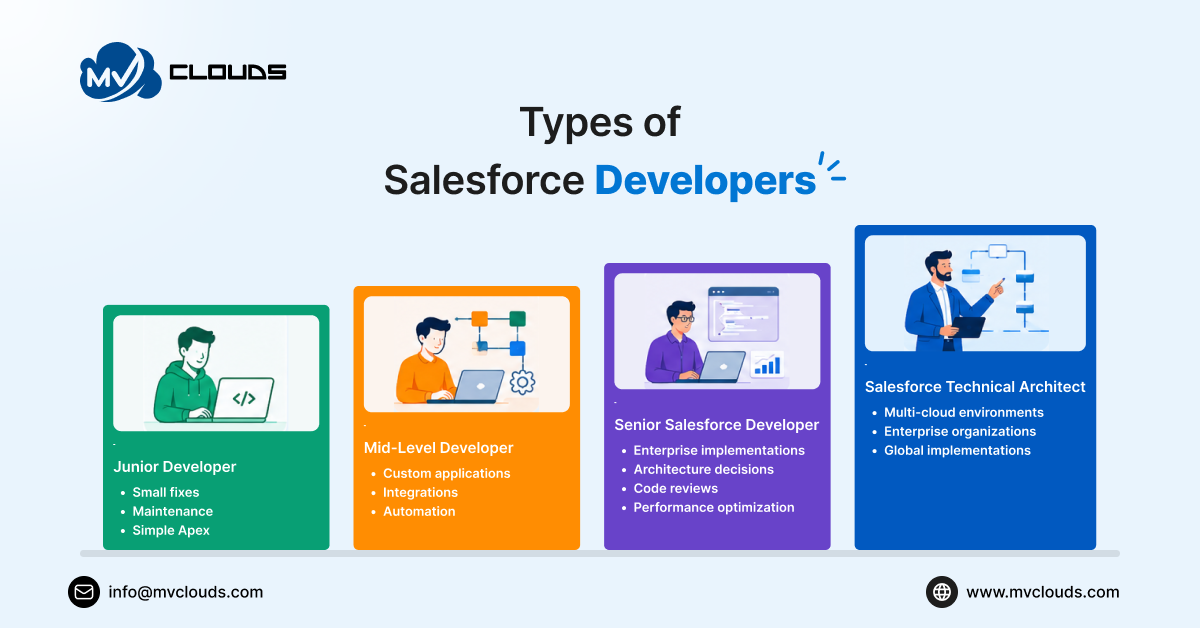
Skills Every Salesforce Developer Should Have
A great developer is more than a fast coder. They need a balanced mix of technical mastery, deep understanding of the Salesforce ecosystem, and clear business communication skills.
Technical Skills
Apex Programming: Writing triggers, asynchronous processes, batches, and scheduled classes.
Lightning Web Components (LWC): The modern framework for fast UI design, plus legacy Aura component skills for older systems.
SOQL & SOSL: Writing optimized database queries to find and filter data quickly.
Flow Builder: Expertly combining declarative (no-code) automation with custom programmatic code.
API Integrations: Experience building securely connected services via REST and SOAP.
Data Modeling: Proper schema design (objects, relationships, master-detail structures).
Security Architecture: Profiles, permission sets, role hierarchies, and sharing rules.
Version Control & CI/CD: Tracking code changes in Git and deploying cleanly via pipelines.
Salesforce Clouds & Soft Skills
Cloud Competency:
Sales Cloud & Service Cloud core frameworks
Experience Cloud (customer portals)
Revenue Cloud (CPQ systems)
Marketing Cloud foundations
Essential Soft Skills:
Business Translation: Understanding operational goals and turning them into efficient technical solutions.
Clear Communication: Articulating tech concepts plainly for stakeholders and remote teams.
Managing Debt: Politely pushing back on bad architecture requests to prevent technical debt.
Documentation: Leaving clear notes, guides, and annotations instead of system "landmines."
Salesforce Certifications to Look For When Hiring
| Salesforce Certification | Why It Matters | Best For |
|---|---|---|
| Platform Developer I | Validates expertise in Apex, Lightning Web Components (LWC), SOQL, and custom Salesforce development. | Most custom development projects. |
| Platform Developer II | Demonstrates advanced programming, design patterns, testing, and complex application development. | Enterprise-grade custom solutions. |
| JavaScript Developer I | Confirms proficiency in modern JavaScript and Lightning Web Components (LWC). | Rich Lightning UI and frontend development. |
| Application Architect | Expertise in data modeling, security, and scalable application architecture. | Large Salesforce implementations. |
| System Architect | Focuses on integrations, identity management, deployment strategies, and platform scalability. | Complex enterprise environments. |
| Sales Cloud Consultant | Specializes in designing and optimizing sales processes, lead management, forecasting, and CRM automation. | Sales Cloud implementation and optimization. |
| Service Cloud Consultant | Builds scalable customer service, case management, omnichannel, and support automation solutions. | Customer support transformation. |
| Data Cloud Consultant | Implements unified customer data, identity resolution, segmentation, and AI-ready data models. | Customer 360 and AI initiatives. |
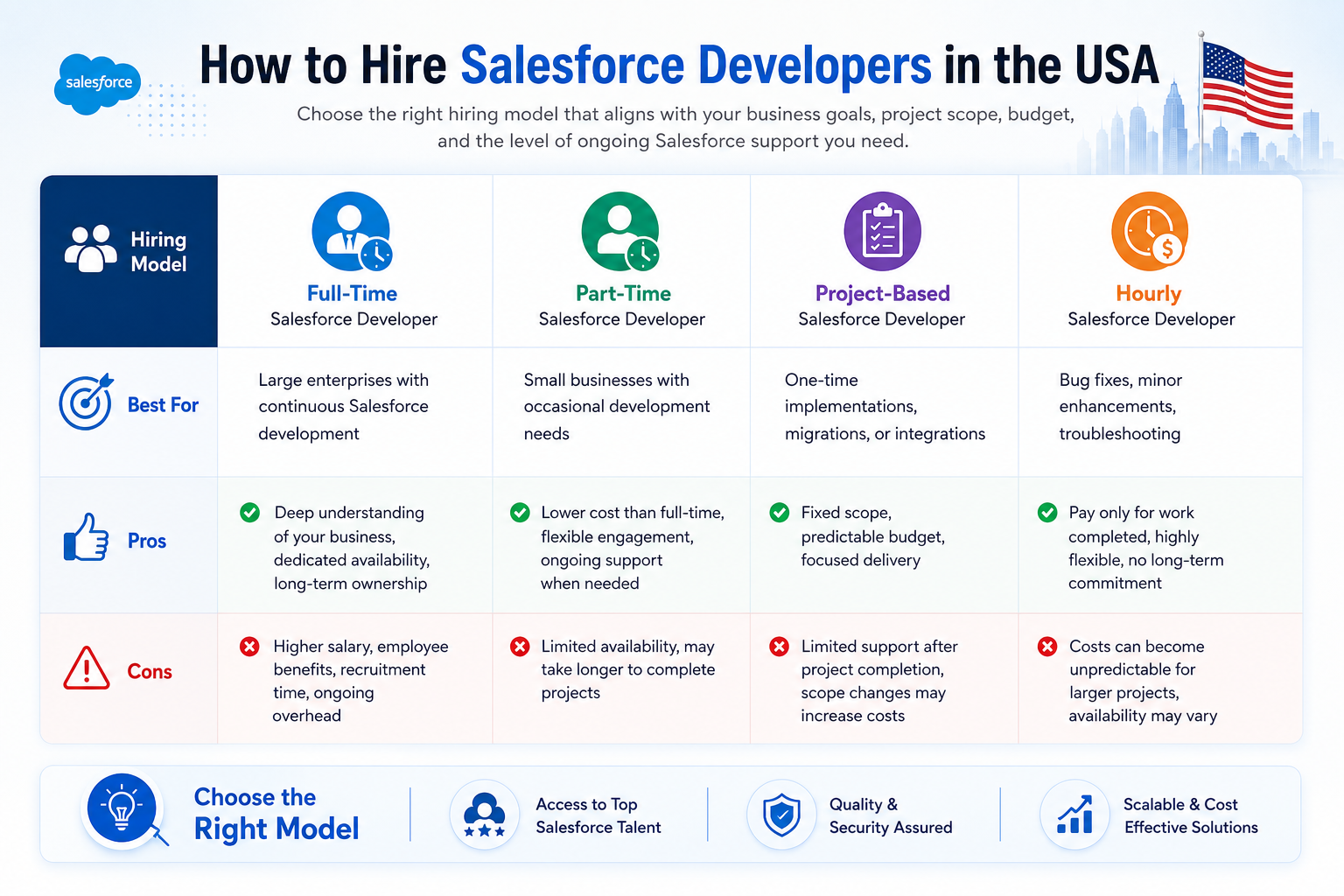
Should You Hire Full-Time, Part-Time, Project-Based, Hourly Rate or Dedicated Developers?
The right hiring model depends on your business goals, project scope, budget, and the level of ongoing Salesforce support you need. Here's a comparison to help you choose the best option.
Which Hiring Model Should You Choose?
Every business has different Salesforce needs, so there isn't a one-size-fits-all answer.
Choose a full-time developer if Salesforce is central to your daily operations and you require continuous development, integrations, and platform enhancements.
Choose a Part-Time Developer if you need ongoing improvements but don't have enough work to justify a full-time employee.
Choose a project-based developer when you have a clearly defined implementation, migration, or customization project with a fixed timeline.
Choose an hourly developer for occasional support, troubleshooting, or small feature requests where flexibility is important.
How to Evaluate a Salesforce Developer
Ask them to explain:
Their largest Salesforce project
Integration challenges
Performance optimization
Deployment strategy
Testing process
Governor limits
Security model
Don't just ask technical questions. Ask how they solve business problems.
How Much Does It Cost to Hire Salesforce Developers in the USA?
The cost of hiring a Salesforce developer in the USA isn't determined by hourly rates alone. While budget is important, the overall value depends on the developer's ability to deliver a scalable, reliable solution that supports your business as it grows.
Costs vary depending on:
Experience level
Salesforce certifications
Industry expertise
Project complexity
Hiring model (In-house or Salesforce Partner)
Geographic location
Salesforce Cloud specialization
A Real-World Hiring Scenario
A healthcare provider plans to implement Salesforce Service Cloud to streamline case management, automate customer support, and improve response times.
They hire a Salesforce developer with strong Apex skills but limited Service Cloud experience because the hourly rate is lower.
A few weeks into the project, they discover that case assignment rules, omnichannel routing, service entitlements, and knowledge management require specialized expertise. The implementation takes longer than expected, and the company eventually hires a Service Cloud consultant to redesign the solution.
If they had chosen a developer with proven Service Cloud experience from the beginning, the implementation would have been completed faster, with fewer revisions and lower overall costs.
Takeaway: Choosing a Salesforce developer with expertise in the specific cloud your business uses can save time, reduce implementation costs, and deliver a better long-term solution.
Why Many US Companies Hire Offshore Salesforce Developers
Many businesses today combine the advantages of local leadership with offshore Salesforce expertise.
Benefits include:
Lower operational costs
Faster hiring
Access to certified talent
Flexible team scaling
Wider technology expertise
Extended development hours
Dedicated support teams
When selecting an offshore partner, prioritize proven Salesforce experience, transparent communication, security standards, and a track record of successful implementations over cost alone.
Final Hiring Checklist
Before signing any contract, confirm that your developer or Salesforce partner can answer "yes" to the following:
✔ Understands your business goals, not just technical requirements
✔ Holds relevant Salesforce certifications
✔ Has experience with projects similar to yours
✔ Can explain architecture decisions clearly
✔ Follows coding and deployment best practices
✔ Uses version control and testing processes
✔ Provides realistic timelines and transparent communication
✔ Offers post-launch support and optimization
If you can confidently check each of these points, you're far more likely to build a Salesforce solution that supports your business for years to come.
Final Conclusion
Salesforce developers aren't just technical specialists. You need someone who can help shape the future of your CRM and support your growing business.
Salesforce developers who are most successful combine technical expertise with extensive business process knowledge. The systems they build are easier to maintain, adapt, and expand over time because they ask thoughtful questions, recommend scalable solutions, and build with modular components.
While certifications are important, practical experience, communication skills, and problem-solving abilities should also be considered.
Think beyond resumes when evaluating candidates, defining your business goals, and comparing hiring models. Your investment today can reduce technical debt, improve user adoption, and maximize your Salesforce ROI for years to come.
Build Your Salesforce Team with Confidence
Finding the right Salesforce developer doesn't have to be difficult. At MV Clouds, we help businesses across the USA hire certified Salesforce developers who combine technical expertise, business insight, and hands-on implementation experience.
Whether you're starting a new Salesforce project, modernizing your CRM, or expanding your team, our certified professionals help you deliver faster and smarter.
Our Salesforce Expertise
Certified Salesforce Developers & Consultants
Sales Cloud & Service Cloud Implementation
Custom Salesforce Development
Lightning Web Components (LWC)
Salesforce Integrations & APIs
Salesforce Data Migration
Managed Salesforce Support
AppExchange Development
Ongoing Optimization & Enhancements
Ready to hire certified Salesforce developers? Contact MV Clouds today for a free consultation and discover how the right Salesforce experts can help.
Frequently Asked Questions
How do I hire certified Salesforce developers?
Select a hiring model that fits your long-term objectives by defining your project scope, evaluating certifications and real-world experience.
Should I hire a Salesforce admin or developer?
You will need an admin to configure, manage users, and generate reports. Whenever you need custom applications, Apex code, integrations, or advanced automation, hire a developer.
What certifications should a Salesforce developer have?
You should start with Platform Developer I. For more complex implementations, Platform Developer II, JavaScript Developer, and Architect certifications are valuable.
Can I hire a dedicated Salesforce developer instead of a full-time employee?
Yes. Dedicated developers offer flexibility, faster onboarding, and access to specialized expertise without the overhead of full-time hiring.
Is offshore Salesforce development reliable?
It can be, provided you work with an experienced Salesforce consulting partner that follows secure development practices and maintains clear communication.
Why should I hire a Salesforce developer in the USA?
Hiring a Salesforce developer in the USA provides advantages such as better alignment with your business hours, knowledge of local business practices, and easier collaboration. However, many US companies also work with offshore Salesforce development teams to access certified talent, reduce costs, and scale projects more efficiently while maintaining high-quality delivery.
Is it better to hire a Salesforce developer through a consulting company?
For many businesses, yes. Salesforce consulting partners provide access to certified developers, architects, quality assurance engineers, and project managers. This reduces hiring risks, speeds up project delivery, and ensures ongoing support after implementation.
